





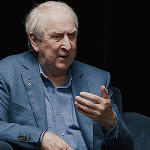

Carrying on the great political tradition of ‘never buggering off’, former Prime Minister Kevin Rudd is back – sort of – offering advice.
To my great annoyance, he might even have a point.
Taking a momentary break from the substantial role of Global President and CEO of the Asia Society, Kevin Rudd appeared at the National Press Club.
Who better, I hear you say, to steer Labor through difficult geopolitical waters than the man with friendly knives embedded in his suit jacket?
Suffice to say he is not on the ‘comeback trail’. (Rudd hinted that Tony Abbott might be.) He is also not running for UN Secretary General because ‘Malcolm [Turnbull] took care of that last time round’.
Kevin Rudd gave a sermon on the rise of China, calling for a ‘radical change in our national psychology’ and a new sense of ‘national urgency’.
Describing Australia as a ‘complacent country’, Rudd said it was his ‘duty’ to warn us about the ‘systemic forces being unleashed across the world’ which have put Australia on ‘borrowed time’. There are, he says, ‘dangers barrelling toward us’, which is news to the Greens and their quest to dissolve Aukus and rely on the shadow of China as if it were the Moon eclipsing the God of War.
Rudd’s warnings come in three parts: the rise of China and confusion of the US, the AI revolution, and ‘the proliferation and intensification of extreme weather events due to rapidly accelerating climate change’.

This might come as a shock to readers, but I agree with Kevin Rudd when he says that people have ‘become numb to the gravity’ of China’s rise, which he also rightly describes as a technoindustrial power with the second largest military and economy.
‘China’s stated ambition is to surpass the United States militarily, economically, and technologically in the next decade.’
He also correctly identifies China’s supremacy when it comes to military construction, such as ship building.
These are not Rudd’s words but rather mine, the advantage of a communist state is the ability to mobilise and indenture workforces which often leads to a miserable and yet dangerously capable military force. History is littered with oppressive regimes that were victorious.
Even knowing the danger, Labor cannot rationalise the unions back to a workable manufacturing baseline in the interest of national security. Why? That is a question for the unions.
Rudd’s comments about China’s economy are less convincing. While they may be correct on paper, China’s economy is heavily dependent on the status quo in which its potential military enemies drive domestic wealth. Without capitalist nations purchasing Chinese products, and factoring in Chinese equity caught up in third-world nations whose position in a global war and its disrupted supply lines remain uncertain, it is likely China’s economy is also its greatest strategic weakness. The US might be a bit sluggish, but its foundations are built on stone, not sand.
The AI race between China, the US, and others is a concern, as Rudd rightly points out.
It does not appear to matter how many AI CEOs or industry leaders publish dramatic warnings … the AI machine rolls on. Government desperation to throw billions at AI as if it were some kind of salvation for the post-Covid, post-Net Zero economy is fuelling a technology that perhaps should be slowed down rather than fed by Treasury.
If all the government money in the world disappeared from AI, how much hype would vanish along with it? We can see this in hindsight for the Net Zero disaster, why not AI? That is probably not Rudd’s point, it is mine, but governments cannot keep throwing our money at AI as a catch-all solution and then complain they are worried about it.
Of course, my comments refer to free market systems. China’s AI race, which Rudd describes, will happen regardless and is unlikely to be run for the greater good of all mankind. No doubt this is the threat whispered by grant-seeking private companies in the ears of technically inept legislators.
On this topic, Rudd said:
‘For Australia this means, alongside our critical debates about AI’s social and economic impacts, these national security threats compel Australia to become a substantial AI power in its own right.’
And while that particular comment may be valid, it does not match Labor’s real-world behaviour in which the government tried to tie-down Silicon Valley AI data centre projects to renewable energy instead of their preferred nuclear source. Or the reality that AI is not being driven by national security concerns, but more often referenced in the ‘productivity’ debate. Their promise of productivity is misleading in itself, as what big business sees as a productive use of AI usually translates to AI replacing human workforces. This is not an improvement. Consider if you receive better service from an AI chatbot or a human being? How do you feel when a corporation leaves you stuck in a tech support loop of brainless algorithms and formulated replies? This is the AI future being prioritised by government because it benefits the bottom line of business. We are in no danger of becoming a powerhouse of military AI warrior code.
‘Incrementalism will no longer work for Australia. Urgency must be our national watch-word if we are to navigate our future as an independent, prosperous, and resilient nation.’
Later on, Rudd spoke highly and accurately about the US’s role in Australian defence, including as a deterrence function. Bite Australia, get squished by the US. That is how it has worked for generations.
It is interesting how determinedly Rudd speaks of the need to upscale our national defence in real-world military hardware. Rudd has been in a position, for many years, to judge geopolitical threats to Australia, especially from China.
All I am saying is that as much as I would usually disagree with the man, his genuine concern should not go unnoticed.
‘It is inconceivable … that in a nation such as ours, in a geography such as ours, would not seek a world-class navy with world-class capabilities.’
Or indeed for a Labor Prime Minister to refuse to reclaim our most critical Port of Darwin in the north from the world’s most likely military aggressor.
‘Lest we repeat the mistakes of the 1930s when conservative governments, in their complacency, left Australia effectively naked heading into the existential security crisis of 1939-1941.’
Where Rudd and I differ is in the assessment of Labor’s defence expansion, particularly with India on the west coast. I do, however, agree with him on strengthening ties with Japan as they share our goals and ultimate strategic interests.
Where I thoroughly disagree with Rudd is on his comments about Australia’s approach to race and religion which he says ‘undermines that security’.
No matter how far backwards we bend in the name of multiculturalism, it matters naught in a confrontation with China. Further, mass migration and multiculturalism have created a military risk in their own right in which a significant percentage of the population does not hold Australia as a first priority, or even a dominant loyalty. This may slip by unnoticed in times of peace, but we know from experience that in times of war it becomes difficult. This is not an argument against all migration, only that Australians with historical ties to the country should always maintain a significant demographic and cultural majority to preserve national security.
‘Remember, the world’s largest Islamic country is also our very near neighbour, Indonesia.’
Indeed, but even if Australia were to become Islamic and all its women forced to cover their faces, it would not save us from Chinese expansionism. In this, Populism is right, and Rudd is wrong.
While Rudd has many interesting and accurate things to say about international politics, his blind spot is the reality of Australian Populism.
It might surprise the former Prime Minister to find out that many of his demands are – if not policy – certainly campaign rhetoric. Populists list national security extremely highly. They want military manufacturing, increased strategic ties, and larger forces. Productivity is a Populist concern, with demands to cut wasteful spending and encourage investment back to the private sector. Populists want Australian children, educated and trained, so they can take up roles in the workforce instead of Labor’s imported migration program. The Populists believe Australians can build a stronger economic ground for future generations and, as we have done in previous eras, innovate for the future. Populists also want to kill off the expensive, unreliable, and China-dependent renewable energy and replace it with cheap, reliable, long-lived, Australian-sourced nuclear power. Populist energy policy is the only policy that can achieve Rudd’s vision for a strong Australia that can stand on its own through a time of regional war. Australian uranium doesn’t rely on Chinese factories, Chinese mines, Chinese supply lines, or Chinese external partners. Populist nuclear policy is not a three-eyed-fish meme, as Chris Bowen would have us believe, but a necessity that just so happens to render decades of wasteful Net Zero investment defunct.
While some of you may be alarmed at my tepid support for some of Kevin Rudd’s comments, I do not believe his warnings about China should be ignored. They seem genuine.
The trick is to keep a whole-picture view of the policy portfolios of Labor, the Coalition, and One Nation in mind while watching the moves of our geopolitical peers. Social Justice activists at the UN can re-draw the world map as much as they like to inflate their feelings, but it does not change the reality that we are a collection of nations grinding up against each other to the point of fatal friction.
There is nothing more dangerous than millions of young men under the command of a dictatorial army, itching for war. They crave the conflict we fear in the same way school children shout for political violence they do not understand.
I will finish with a quote from Hasluck’s The Government and the People:
‘Self-determination, self-government and status were the conceptions with which the minds of thoughtful men played. Most Australians saw more clearly their rights as a nation than they saw any deficiency in their power as a nation.’
It does not matter if we are two years away from war, or 50. We are not making the necessary preparations to survive. Instead of hosting endless productivity summits, Canberra may be better served with a dry run. What would they do, today, if war were declared? I think we’d all sleep a little better if there was some sort of urgency and order put into activating our nation into a pre-war machine. To keep us on our toes, so to speak.
The great war-era Prime Ministers and Presidents are full of regret for what could have been done sooner, but as things stand, our leaders might not survive the conquest long enough to contemplate where they failed.
Alexandra Marshall is an independent writer. If you would like to support her work, shout her a coffee over at donor-box.
The post Kevin Rudd might be … right(?!) appeared first on The Spectator Australia.

