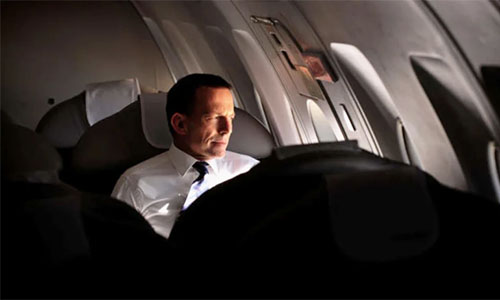



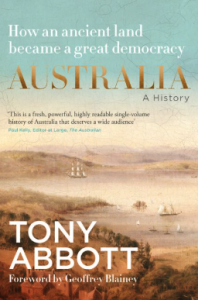
 Peter FitzSimons? Ye gads! An unexpected endorsement, of sorts. Guarded but positive. (Who would even want an endorsement from the man formerly known as the bandanna’d one?) Kim Beazley Jr, a good get from a Labor opponent and perhaps facilitated by Abbott’s and Beazley’s connection on the board of the Paul Ramsay Institute.
Deft marketing by the publisher (HarperCollins), right there.
GREAT
The second was in the subtitle, which often reveals much about the enterprise. “How an ancient land became a great democracy.”
I thought, oh dear. We have an eternal optimist and a great Australian writing about – a great Australia. This is not the country I now see before me.
I firmly believe that Australian democracy has peaked. And that we are now in the territory of inevitable decline and a worsening of our rights and freedoms. For which I believe the evidence is stark and plentiful.

I also know that the author is a still faithful supporter of the Liberal Party that nurtured him – then mercilessly destroyed his political career. To the massive cost to us all.
Does Abbott’s fresh new history restore my sense of belief in a great Australia? Is Australia’s current democracy a busted flush at best, a clusterfuck at worst?
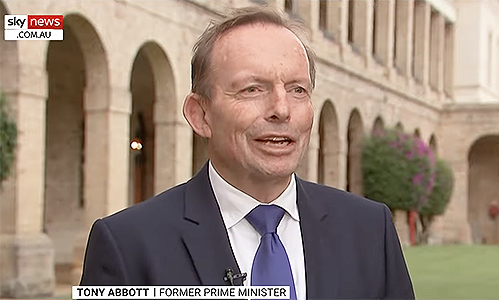
Viewers of the Sky News doco will have gotten a taste for the book and its story. Abbott’s interview with John Anderson is a good intro.
I was on a train from Sydney to Lismore the other day. I had put down the new book on Andy and Fergie by Andrew Lownie, a page turner if ever there was one, and had Tony’s book on my tray table. My next read.
The woman next to me suggested, having watched the Sky News doco, that Abbott was trying to “reinvent himself”. WTF?
This is the soft-Left view of Abbott. A bad guy, on the make. I didn’t bother to push back. Doctors’ wives of a certain age will have their views.
I saw no point in prosecuting the case for Abbott to a superficial stranger. Abbott the author is Abbott the man. He hasn’t changed.
It would be a bizarre move on his part, at this stage of life, to present himself as someone different to his image among foes.
No, what you see in Tony the historian is what you have always seen. If ever there was one more sinned against than sinning, it is TA.
It raises questions, though. Will the book be taken seriously? Will the identity of its author colour perceptions? Will the book get the silent treatment? Will it even be on the bookshelves, given the strategic biases of our publishing cabal?
A couple of people have told me that they were pleasantly surprised by the doco. And Tony Abbott, a trained journalist by original profession – the priesthood having been discarded – is a naturally gifted writer, always thoughtful, considered and moderate in tone. In contrast, perhaps, to his exuberant university days and the vigour of his rugby days in Australia and his boxing at Oxford.
Certainly, his writing contrasts with his feistiness in Parliament, both in government and in opposition.
Abbott’s book is, expectedly, a good news story of a nation he still loves, with its embrace of the three pillars of our story.
The Aboriginal foundations, the British settlement and the migrant cultural add-on. Abbott sees this as a win-win-win.
CONTESTED
This view is highly contested, now, and not only on the fringes. The alt-view sees decline, conflict, the crushing of our British cultural inheritance, highlighted by organisations like the British Australian Society, the train wreck of multicultural ideology and endless division rather than happy times. And the exclusion of contrary views, on issues like mass immigration.
Britain, the land of Abbott’s birth, is also going through the wars. Some see a hot civil war coming, there.
Just about everyone there knows the cold civil war has already arrived, mostly on the back of mass, popular resistance to uncontrolled immigration by people known to be antagonistic to British values and traditions, and in no way inclined to integration.
The evidence for the alt-view can be seen in the recent March for Australia rallies, though no one here speaks of a civil war.
These people would reject the Abbott optimism and the narrative. They might well accept his thesis, up to twenty years or so ago. They believe things have changed. Irreparably.
They now see a Uniparty made up of bad actors with shared globalist agendas that seeks to crush us. Not to enrich us.
Tony Abbott’s Australia still exists. Of course it does. The great stories. The optimism. The values. But it exists only in anecdotes, not in the complete story of where we are now. The great Australian story exists now in exceptions.
The grumpiness exists in the rallies. It isn’t a secret. Is Tony Abbott simply trying to plug the holes in the dykes?
It is the 60 per cent. The middle bit. Many among the 20 per cent core Left will dismiss Abbott forthwith. Some among the 20 per cent on the “far Right” will see Abbott’s defence of our nation as quaint and out-dated.
Abbott says early on that many Australians are now “ambivalent about our past”. I, on the other hand, am highly relaxed about our past but decidedly ambivalent about our present.
Abbott would probably see his main task as providing a corrective for the former rather the latter.
This is a book for the remaining 60 per cent. One view of this middle bit is that they are low information voters, devotees of either branch of the UniParty, endlessly distracted by toys, trinkets and addictions.
Or maybe they are the fellow travelling optimists who, if they buy a copy or at least watch the Sky News version, will find Abbott’s approach refreshing and congenial.
Alas, these people may not be the ones buying this book. Abbott notes the ignorance of many about our past.
More than this, he laments it, and seeks to correct this. Noble work. It is an educative task, and so valuable. In theory.
DOUBT
Will the nearly half of our population born overseas or having a parent born overseas pick up a copy? I doubt it. It would be a great primer.
Perhaps we should demand it of new arrivals. Have you read Abbott? No? Well, here is your copy. You will be tested on it.
Abbott comes across in the book as measured, restrained, open-minded, respectful of opponents, not out to prove a political point.
What would that point be, in any case? Yes, he has his position. But he is never shouty. He is dispassionate. This makes the book a very relaxing read. And a good book for a man in his sixties who has achieved very much to have written. With deep perspective.
Overall, a gentle read. An easy listening history. And this is not meant as an insult. From a reader in his sixties, too.
Some of us will know much of the detail already. It is very much a political history, so students of politics will find much of the material, certainly since the 1960s, familiar.
As political history, it is both comprehensive and engaging. But there are also snippets that are new, or, at least, previously parked.
Abbott’s asides on key figures in our political story are revelatory and rewarding. His observations on Menzies and Howard might be seen as predictable.
But his observations on major players like Arthur Calwell and Paul Hasluck – look them up – are valuable, and sometimes moving. These are the personal touches that leaven the higher-level narrative.
Abbott’s clear affection for Bob Hawke resonated with this reader.
The book is also a work of meticulous scholarship, evidenced in the footnotes and bibliography, but lightly worn in the text.
What emerges, as a result, is a work of deep research without the trappings of narcissistic, academic wank.
This turns out to be serious history, as the endorsements from the great Geoffrey Blainey and the great Andrew Roberts confirm. Its excellence even Peter FitzSimons (or his agent) could grasp.
CONVICT
For me, the earlier years of our history were the most interesting. As the great, great, great grandson of a convict (who arrived in 1801), I feel no personal responsibility for the great dispossession by the Brits. But it also biases me towards the early years that are less familiar. Here TA does a very good job.
Has he convinced me that our great national project has not run out of puff? No, he hasn’t.
But that wasn’t his intent. He had other tasks, important tasks, mainly to get more Australians to understand and cherish our past. Not to fret about our current trajectory.
It would be churlish to critique a book for what it didn’t do, and perhaps had no business doing.
In addressing our grave national deficit in knowledge of our largely noble past, Abbott might just be instilling in more of us a desire to do our bit in taking on the increasingly urgent task of repair that many of us see as now being “line in the sand” time.
The indicators of this need are emerging daily.
Now – to take one random example – the Australian Federal Police are creating a task force to root out people and organisations that might be seen as threatening the “social fabric”. Sinister forces are at work, and are embedded in government institutions.