







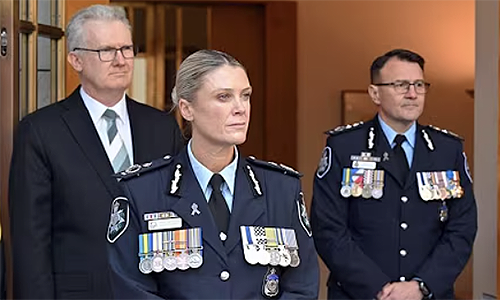

The eSafety Karen continues her reign of online terror. The Australian Federal Police has a new commissioner. Called, almost inevitably, Krissy – Krissy Barrett.
As if Christine Nixon wasn’t bad enough. And this week the AFP has announced it is coming after dissidents and other troublemakers. Those who “threaten social cohesion”.
THREATENS
Not a good start. Not a good sign. And who defines what threatens social cohesion? Probably a woman.
Two things have happened recently to bring these matters to a head. Or, at least, to my attention.
The first was the publication of a hit piece by Helen Andrews on the feminisation of everything, especially the feminisation of the public square. Of all of our cultural institutions – politics, the law, academia, the third sector and business.

The second, just the other week, was the one hundredth anniversary of Margaret Thatcher’s birth.
Talk about replacement theory.
Andrews thinks that feminisation equals wokeness. It is her hypothesis, and this one might just be a working hypothesis that does work. She goes much further.
She says that the feminisation of society might just be the end of Western Civilisation. And not merely another case of an interesting social development.
Feminism contains within it a fundamental change of course. The replacement of male thinking, with its focus on reason and rules, with a new focus on raw emotions.
Yes, we have always had queens like Boudica and Gina Rhinehart. But this is new. It is all encompassing and consequential.
Helen Andrews agrees with Tyler Cowen (a libertarian economist of note and merit) who has called this one of the great revolutions of his time.
Her evidence is compelling. And it goes to a fundamental change in philosophy and not just to a change in chromosomes.
The feminisation thesis is talking about two things at the same time – the acquiring of majority status by females in the workforce, and their rapid (in the past five years, even) advancement en masse to senior management positions in core institutions. A double whammy.
And, as Andrews notes, it is unprecedented in human history in its extent and speed.
Andrews makes a strong case that feminisation has caused wokeness. We have gotten woke because of feminisation.
So, we come to Margaret Thatcher. I recall a colleague at RMIT, by definition a Leftist, who once shared with me that he would be cheering at the death of Margaret Thatcher.
A case of pre-Charlie Kirk neo-marxist compassion, perhaps. Not unexpected. They are excellent ideological haters, who actually mean it. Pretty disgusting, really.
Thatcher was perhaps best summed up by an anecdote about her. I have no means of confirming its authenticity.
She took one of her early Cabinets out to dinner. Naturally, she ordered. The waitperson asked what they would be eating. Thatcher said, “the beef”. “And what about the vegetables”, the waitperson asked? Thatcher said, “oh, they’ll be having the beef too”.
She shone in domestic, then in international, affairs. Her economic reforms were needed. Her management of the last days of the Cold War was deft.
She missed what was going on with the cultural revolution, and she got climate change badly wrong, for the wrong reasons.
DEMISE
Just like Reagan, she suited the times. Neither of them offered solutions to our more recent Western demise, post the Cold War.
That’s life.
She was hated, of course, by the then emerging woke crowd. Even as a woman, she was “not one of us”, a reaction that neatly showed how the new elites were just as prejudiced as the elites they replaced.
She became the Uncle Tom of the sex wars. Just as Leftist blacks despise Warren Mundine, so do feminists despite the Maggies of the world. Funny, that.
Thatcher’s problem? She ruled like a man. Not like a Leftie feminist.
The British conservative, Peter Hitchens, never a fan of Thatcher’s, has contributed.
Hitchens loved her personal story but declined to endorse her policy legacy. And this from a conservative of note. And his revisionism about Thatcher is compelling.
He contrasts Thatcher’s reversible reforms, for example, with Blair’s calculated, embedded, revolutionary changes. That have stuck, just as he intended.
Thatcher, it seems, was loved and hated in equal measure, for the wrong reasons.
Thatcher’s “revolution” seems now inadequate and inconsequential, given events since.
But Hitchens’ analysis of her reign was not about her gender. It was about her policies. Which raises the question, does gender matter?
Helen Andrews addresses this. Her view is that the revolution is now all but complete, and it isn’t about “role models” or some such.
It turns out to be not just about getting women to the top, but about getting the correct women to the top.

As a true blue Feminist of the 1970s, I tend to agree with this article. The current female revolution has delivered a mess. Me2 – Cancel Culture-Witch hunt mob mentality, trigger warnings and all the while screaming for more women at the top and trans men are women too. I mean WTF – yes empathy is a good thing but in big business ya gotta be pragmatic. The worst example is the current feminized Judiciary with their compassion for the perp, or the Teals with self righteous zeal all the while ignoring families in rural areas being ripped up by the Renewable bull dozer.
The answer to your first question is that labor is promoting women beyond their abilities to get more votes. Similarly labor fauns support for abos and non-caucasian immigrants for the same reason, and to hell wth the consequences. All they want is to keep their snouts in the trough. But what can one expect when we only have a half Australian bas tard for PM? (Read the unauthrised biography.)
Not all men are good leaders and not all women are good leaders. Women ARE different from men, and so have different attitudes and priorities, and are subject to varying physical influences eg women tend to be more emotional (eg. women scream in various situations, whereas men tend not to). Women tend to be softer and so are much better than men at child raising (naturally), but is a handicap in making tough decisions. Most women are not good when it comes to fianncial management (many men aren’t either). A small percentage of women rise above those handicaps, and are outstanding leaders. Personally I think more men make good leaders than women. Then of course there is the problem of bias. Most men will assume that women will not be good leaders, and so it becomes more difficult for good female leaders to succeed.
Mrs T said “I owe nothing to Women’s Lib”, and made herself the target of feminist rage.
Metaphorically speaking she had more downstairs than just about any ‘conservative’ male politician in the last fifty years.