


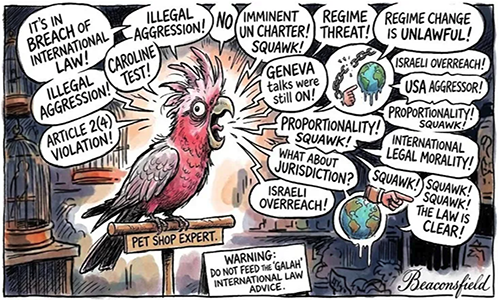
I should point out to non-Australian readers that a “galah” is a common Australian bird, but in slang it refers to a fool or idiot.
I studied international law at the universities of Sydney, Paris and London.
TRADITION
I taught international law at the University of Technology Sydney and – when that British giant of international law, Professor DHN Johnson, was ill, – I stepped in to ensure that the long tradition of teaching this subject in the nation’s oldest university, Sydney University, could continue.
I’ve participated in conferences, seminars and in international organisations in various countries.
Nevertheless, I’m well aware of the weakness of international law and the charge that it is not law or that it is a primitive form of law.

The weakness is that there is no international legislature; despite the name, there is no real international court, and there are no sanctions for breaches of international law except by the victims of those breaches.
Australians saw that, particularly in trade, when Beijing disregarded international trade law and the free trade agreement with Australia, to punish the country for the Prime Minister correctly proposing that there be a genuine international inquiry into the origins of COVID. We now know it came from one of their military-controlled laboratories.
What is perhaps not surprising, and probably predictable, is that those who oppose President Trump – and those who are sympathetic to the Iranian regime – have come out and declared that what the United States has done is in breach of international law.
In so doing, they are expressing an opinion, nothing more.
In my view, whatever international law is, there is absolutely no breach of international law in the actions of the US and Israel.
A separate question – and the one currently paralysing the halls of Congress – is whether the President has breached the United State’s Constitution.
On Wednesday, March 4, the Senate rejected the Kaine-Schumer-Schiff War Powers Resolution in a 47-53 vote.
While the “galahs” squawk about “illegal wars” the legal reality centres on the tension between Article I (the Congressional power to declare war) and Article II (the President’s power as Commander-in-Chief).
The President is not in breach. Under an originalist interpretation of Article II, the Commander-in-Chief’s inherent authority to use military force to protect “important national interests” and neutralise imminent threats without waiting for a committee meeting in Washington.
THREAT
The administration’s brief correctly argues that in the nuclear age, the “imminence” of a threat to the Republic justifies unilateral executive action.
It may well come before the United States Supreme Court, which, contrary to the Constitution, has seized the power to declare acts of the government invalid.
The Court has a shocking record of issuing decisions that are difficult to justify and that have had shocking consequences – the worst being Dred Scott, which many see as a primary cause of the Civil War.
On the matter of war powers, however, the Court has historically recognised that the President must have the agility to defend the nation in a theatre of war that now moves at the speed of a missile.
Predictably, the pet-shop galahs have extended their “expert” views to the recent downing of an Iranian ship.