







The other is far more serious. We are all too familiar with the size and the impact of debt on our lives.
In just 20 years we have gone from being a nation of 19m people and no debt to 27m people and a previously unimaginable mountain of debt.
TRILLION
Actually, $1.6 trillion if you add on the State’s debts.
What these dreadful figures tell us is that all of the income our governments have received from taxes and charges for the past 20 years, plus what Peter Costello left in the bank for Kevin07, has been spent, it’s gone!
Not content with spending all of our money, consecutive governments – and again these Labor governments across the country are no exception – have grabbed hold of the national credit card and spent another $1.6 trillion.

The bitter pill is that the debt is not theirs, it is ours. It has been incurred by people we elected to manage our country and its finances.
Now, too late, we realise they have made fools of us and have put us deep into the merde. Productivity is stagnant and inflation is obstinate – so interest rates must go up again.
Albanese and his numerically illiterate Treasurer have told us they going to continue the spending spree, so there’s nothing we can do about it until we get rid of them.
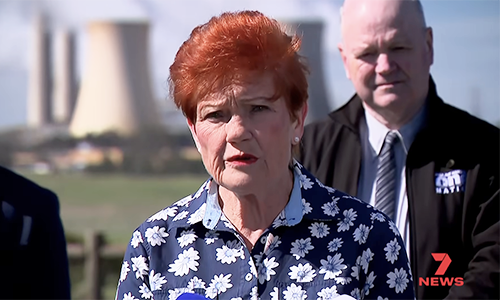
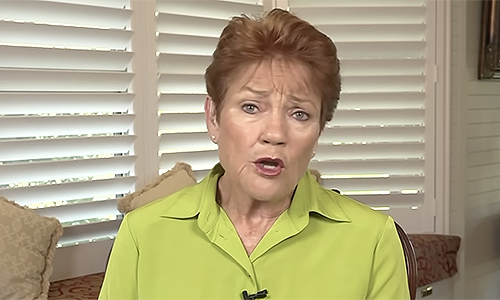
As I watch a totally irresponsible Labor Government and a lame Opposition, the only solution to get out of this hot mess is to give Pauline Hanson and One Nation a go.
Those from both sides of the House – who have told us they’re the only ones fit for the task – have, for the past 20 years, failed.
So here we are. A very big island, with 27m people mainly of Judeo-Christian values in the middle of a big ocean on the edge of a booming Asia – and we’re broke.
We should now consider what the Deputy Prime Minister really meant when he addressed the National Press Club on April 16 this year.
Richard Marles told the Fourth Estate that Australia faced “its most complex and threatening strategic circumstances since the end of World War II”, as “international norms that once constrained the use of force and military coercion continue to erode”.
What that means in plain language is that our part of the world is more militarily fragile than it was in 1945, or, we have China as a neighbour, on whom we rely for almost everything, and China’s belligerence in the region is growing.
We had an experience of that belligerence recently when Beijing sent a small fleet to do a circumnavigation recce on Australia and practice some live fire drills.
Not only didn’t we know they were there (a passing commercial airline captain raised the alert), when we did learn, we didn’t have a ship of any kind that could keep an eye on them.
And worse, we didn’t have a refuelling tanker that could keep our war ship at sea had we had one capable of keeping an eye on them.
ADMIRAL
The Chinese navy did their sight-seeing, mapped what they wanted around our coast, found out where all the under-sea cables are that connect us with the rest of the world, and went home with their Admiral on his bridge quietly humming Waltzing Matilda.
At the time I enquired about our Collins Class submarine fleet and was told there was only one out of six in service. The rest were, and still are, in pieces around Australia.
The terrible truth we all have to face is that during those 20 years we have not only racked up $1.6 trillion in debt, we now don’t have a navy worth a cracker.
Which means we have lost our ability to keep our vital shipping lanes open. For a trading nation living on an island, that is a serious problem.
We are well on the way to being in the same position to what Churchill and Britain found themselves in 1939, and that is being reliant on others for our food.
National Party Leader Matt Canavan has just woken up to something I have been writing about for at least the past five years, maybe longer, and that is we are no longer self-sufficient in food.
Do not believe the claims that we grow enough food to feed many starving millions because it is a false claim.
What Australia grows are sufficient calories to feed millions of people. Our two biggest rural exports are grain and meat. Both are what the statisticians call unimproved.
That is the grain is as it was harvested and the meat is frozen and in bags and boxes, both have to be processed one way or another before they can be consumed.
About 16 per cent of our imported food, worth $27.6b landed, now comes from Singapore and China.
That does not mean Australia would starve without them, but it does mean that any disruption in those supply lines would be quickly felt— on supermarket shelves, in food factories and around kitchen tables.
UNCOMFORTABLE
That is the uncomfortable point we now have to face. No one sensible is saying Australia is about to run out of food next Tuesday.
We are still a great producer of grain, meat, wool, dairy, sugar and other staples. But food security is not simply a question of how many tonnes of wheat or beef leave our shores.
It is a question of whether a modern nation can keep its people fed, week after week, when the shipping lanes become uncertain, the supply contracts become political, fuel becomes short, fertiliser becomes scarce, or friendly suppliers suddenly have problems of their own.
That was Britain’s lesson in 1939. Britain didn’t go hungry because there was no food in the world. It came close to starving because the food it needed was somewhere else, and enemy submarines stood between the British people and the ships that carried it.
The sea, which had made Britain rich and powerful, suddenly became its weak point. The same geography that protected an island nation also made it vulnerable once its daily bread depended on other people, other ports, other ships and other navies.
Australia should study this example very carefully. We are not Britain in 1939, and China is not Germany in 1939, but the strategic principle is the same.
An island continent that assumes the supermarket will always be full is an island continent that has forgotten what war, blockade, sanctions, fuel shortages, cyber-attacks, port strikes and shipping disruptions can do.
The modern supply chain is marvellous when it works, but it is brittle when everyone wants the same ships, the same fuel, the same fertiliser, the same medicines and the same food at the same time.
The old saying is that the one thing we learn from History is that we do not learn from History. The reckless spending of the Whitlam government 50 yrs ago, and equally reckless spending of Labor and some Liberal governments since then has been forgotten by the senior voters, and never even examined by junior voters under 40. Even Common Sense has not guided voters that no government can keep spending without restraint. Constitutional restrictions and/or Citizens (non-Constitutional) referenda are the only way to bring financial discipline to governments.
Albanese is a student activist. Of all the vile people at Universities, student activists are the worst. They are vain psychopaths who only care about their contrived issues which are designed to make them look better then ordinary people. Albanese’s are the Voice and every other stupid woke issue, and most destructively, global boiling which according to the CSIRO is going to cost Australia between $1/2 trillion and $1 trillion; all wasted.
Then there is this:
https://kangaroocourtofaustralia.com/2024/12/12/anthony-albanese-thai-massages-and-his-mates-graham-richardson-alan-jones-and-lachlan-murdoch/
Putting the political situation into perspective please consider that Albanese Labor was elected to government in May 2022 and again in 2025 a year ago, and now they are into the fifth year of government.
There was no cost of living crisis before 2022, immigration intake under Coalition governments based on ABS statistics and 2000 to 2007 then 2013 to 2022 were 126,000 a year and then 169,000 a year average.
Labor 2007 to 2013 had the first “Big Australia” policy and immigration intake increased to an average of 259,000 a year. From 2022 to 2025 the intake increased to 424,000 a year average.
One Nation say if they were in government in 2028 the intake would be 130,000 a year, well that is not settled because they have an internal argument with at least one MP claiming all factors accounted for it would be around 230,000 a year. All factors not accounted for when 130,000 was announced, apparently?
Indeed they are also disagreeing about the first policy announcement that all non-residents would be forced to sell property they have purchased, former Coalition Deputy PM who served with Prime Minister Turnbull said that would not be fair and reasonable, forcing sales.
It highlights the lack of resources, the lack of experienced in government and governance within One Nation, with 4 Senators and 2 House of Representatives MPs, compared to Greens 10 + 1 elected.
Over thirty years President and Leader Senator Hanson has been a career politician. She left school early and worked in her parents shop business, later started a potato chip processing business and then kept records for her husband’s roofing and guttering installation business (not a plumber as often claimed).
Many if not most Members of Parliament are university graduates in law, economics, finance and of course they are important qualifications to have to participate in Parliaments, and even more important for managing portfolios in government. And while not essential there are usually many more qualified MPs than not.
Pauline Hanson’s One Nation was established in Queensland and remains based there, she is the President and Leader for life, and if she retires there is no party membership democratic voting for a replacement, she has the right to appoint.
I understand why voters are interested in One Nation, the headlines, mission statements and cartoon promotions are interesting and good public relations, sales and marketing. But what about the details, see above immigration and property ownership confusion of policies. Of no substance when analysed.
We need to get rid of Labor governments, the Liberal National Coalition are a major party and One Nation is a minor party based on elected members. In fact they did not get one MP elected 2022 or 2025 and the primary vote half the Greens primary vote, One Nation 6%. Therefore, and noting that One Nation does seek an alliance with the Coalition that at other times they criticise, One Nation is not prepared or qualified for official opposition, and therefore governing, consider cabinet portfolios and the public service bureaucrats government must deal with.
So, are you saying in so many words JohnW that Pauline will make the current situation even worse? That would require real talent. The current uniparty has gone out of its way to destroy this country. I’ll take anyone who at least wants to stop this rot. All ON needs to do is to set the policy direction AND say “no” (for once) to the out-of-control bubble bureaucrats.
Noting 30 years of PHON now ON Party based in Queensland and never achieved opposition or government states or federal. Not one MP for House of Representatives elected at either 2022 or 2025 elections and until two were gained just four Senators. President-Leader for life a Senator and will choose her successor with no democratic voting by party members permitted.
What I am pointing out is that there is too much political misrepresentation, Uniparty tag is an example because if that party existed it would have to be Labor+Greens+Teals. And why does One Nation seek an alliance with Liberal National LNP parties Coalition if they are not conservatives?
I know why, because as poll analysis repeatedly indicates that despite latest polling results One Nation attracted a very low 6% of primary vote 2025 (Greens 12%) and if preferences are scattered again by division within the conservatives Labor is going to be returned to government on preferences distribution.
However, and as former National Party MP Joyce has commented recently, if One Nation gained too many new MPs they would be inexperienced and require mentoring, and therefore he will not seek to move to the Senate because his qualifications and parliamentary experience will be needed. Of course there will be new Coalition MPs elected, the difference being the Coalition has a track record in government and in opposition and have many with Joyce MP qualifications and experience. And are the official opposition sitting opposite every government cabinet portfolio.
I lived in Queensland for several years and my local state MP was with PHON, that short few years of One Nation having several state MPs ended quickly. And noting many members have left the party over the past thirty years disenchanted, I understand that a dictatorial leader does not create a happy workplace.
Also, repeating the relentless negativity of the leftists, now used at least in part by One Nation campaigning to not look like six elected people (Greens eleven), ignores the Coalition in government achievements. There was no cost of living crisis before May 2022, immigration intake was well under control and One Nation’s lowest estimate of 130,000 is in line with actual Coalition intake years.
By the way, I do not believe the Coalition is perfect, that in government they have not made mistakes, however compared to Albanese Labor now into their fifth year of government the Coalition were excellent.
For 50 years the lazy Australian has fed themselves on government regulation now showing up as 1.6 trillion dollars in debt and productivity in the sewer. The housing market spells out the waste.
Please, please never forget that Albo’s new wife Jodie is a coastie, a real coastie.
No PM has ever been the Liar Albanese is. He is so ideologically unsound, he is incapable of recognising the devastation he has caused.