



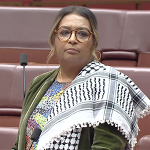
Remember when Jacqui Lambie fantasised about throwing Elon Musk in jail? I had forgotten until Damian Coory pointed it out on our Friday Speccie TV show.
Speaking on News24, following X’s refusal to take down newsworthy footage featuring the stabbing of Bishop Mar Mari Emmanuel, the Tasmanian Senator said:
‘When it comes to the tech billionaire, like I’ve already said, I think he’s a social media knob with no social conscience. He has absolutely no social conscience. Someone like that should be in jail and the key be thrown away.’
Funny, plenty of unvaccinated citizens had similarly uncharitable thoughts about the Senator when she said this:
‘…those anti-vaxxers out there – or that 20-30 per cent – the ones out there protesting in the streets and doing that sort of thing, I think you’re going to find the rest of us coming at you lock, stock, and barrel. We’re going to be putting the pressure on you fairly hard because the rest of us that are trying to do the right thing by the country and our kids and get vaccinated. I think for you, we’re going to start to get even more agitated, and we’re going to start to get more hardcore. That’s what you’re going to see, massive division out there, and it will be us on the front foot.’
There are other instances in which the Senator criticised anti-lockdown protests and those who made a choice to reject a vaccine that had more serious side-effects than originally disclosed to the public. Any later nuance added by Lambie does not undo earlier remarks.
What was, for over a century, considered sensible hesitancy toward new medical developments found itself incomprehensibly radicalised by Canberra as some sort of unhinged conspiracy movement to be scorned and punished.
Even now, the takeover of global society by an axis of hypochondriacs, fear-mongers, and tiny people wielding power for the first time is remembered as a fever dream whose tangible marks on society endure as social-distancing stickers in public spaces, boarded-up storefronts, and the occasional person dressed like Hannibal Lecter at the supermarket.

It never seemed to matter to Canberra that none of the vaccines lived up to their promise of stopping transmission, which was the excuse used to underpin mandates, fines, and Covid passes.
Any public dissent, no matter how well-supported, was fodder for increasingly unhinged media and a political class so frightened of stepping out of line with the WHO that they remained, for the duration of the pandemic, devoid of agency. Covid proved that globalisation does not require ratified treaties to enforce compliance – incompetent politicians obey for lack of a better idea.
What happened to the Australian people was wrong and there have been no consequences for the politicians, advisors, and corporate interests who contributed to the saga.
Last week, I spoke in front of a full house calling for a Covid Royal Commission. Personally, I do not place much stock in Royal Commissions, given we are currently wading through the farce of an Islamic terror attack triggering an investigation into ‘Antisemitism and Social Cohesion’. What disingenuous rot. If we had a Royal Commission into Covid it would end up titled: ‘#Freedumb, domestic terrorists, and the evils of Populism.’ That is the level of government integrity we are working with.
Regardless, Lambie’s Covid-era comments came from the lips of someone occupying a rare position of power and privilege. She was free to speak while the victims of Covid were having their voices removed from social media either through inhouse community guidelines or by request of the federal government. Her dismissal and antagonistic approach toward the free speech of others, particularly when expressed about a social media platform or in the well-worn format of satire, is concerning.
Politicians do not seem to realise that people’s attachment to social media platforms such as X is proportionate to how badly they were treated by Canberra and the media class. Of course people value a platform that offered them a voice. This is not the witchery of algorithms.
After Elon Musk purchased Twitter and renamed it X, he divulged the extent to which the Australian government sought to censor the victims and dissidents of the Covid era. In other periods of history, the individual exposing this sort of government behaviour would be held up as a humanitarian.
The most amusing part of Lambie’s comments regarding Elon Musk were her threats to not only leave X, but take the rest of her Parliamentary friends with her. As someone who has been part of X since its earliest days, it was never better than before politicians tried to use our social media space to promote themselves.
Lambie deleted her account in 2024 and almost no one noticed, except Elon Musk, returning verbal fire with a tweet that read: ‘She is an enemy of the people of Australia.’
That was his opinion.
Remember, this was in relation to the Australian government wishing to take down footage of an alleged terror attack that was not only newsworthy, but in the public interest. There were no such calls do take down footage of the Bondi terror attack.
Why do politicians frown upon free speech platforms when they put up content similar to news broadcasters?
It is easy to speculate on why so many politicians dislike X when compared to the heavily-regulated, co-dependent relationship of the mainstream media with Parliament. Traditional media is careful in its criticism of politicians and their policies because they require politicians to attend their shows otherwise their business model breaks. This is an unwritten understanding that works as an incredibly strong censorship tool. Social media is a collection of voices that have zero interest in the feelings of politicians or the reputation of political parties. On social media, politicians are exposed to public opinion outside the carefully curated yes-men of Canberra and reassuring smiles of producers.
Politicians around the world have been trying to shut social media up. Australia has the disturbing reputation of ‘leading’ in digital censorship, ushered in under the false premise of ‘child safety’. We know child safety is an excuse, not a driving force, because it only entered the chat years after the war against free speech began.
Child safety is the same sort of fabrication as the climate apocalypse. They are both meant to shield objectionable policy from criticism by falsely invoking moral outrage. And the press let them get away with it.
It is not only that politicians hate being wrong or having their policies torn apart, social media can and does tip elections. Previously, that was a privilege reserved by the media. Indeed, social media stole that privilege because the power is based on trust. People trust each other, not suits behind desks.
Elon Musk’s X was not the first social media platform to have significant electoral influence, it is just that Canberra did not care when Democrat-dominated Silicon Valley was toeing the global left party line. There were no calls for child safety censorship when conservatives were the ones being shadow-banned or deleted.
If the Coalition were actually a conservative alliance, they would have provided balance and moved to protect X and social media from politicians and government. Unfortunately, their fear of digital scrutiny is far stronger than any allegiance to the Ghosts of Western Civilisation.
Once politicians were allowed to normalise calls for censorship as ‘safety’, it was unsurprising to see censorship extended to satirical cartoons.
Buried in Lambie’s response which referred to Pauline Hanson as a ‘maggot’ was something far more concerning:
‘…you don’t stand like a coward behind your goddamn cartoons. How they are allowed to go over social media is beyond me because they incite hatred. They are vile. They are disgusting and are absolutely obscene.’
That may be Lambie’s view, but the general public find Please Explain immensely entertaining and innocent enough to appear on social media without any content warnings. They are many orders of magnitude more mild than things like South Park. Even The Simpsons is harsher.
The cartoons are sharp political commentary on politicians, parties, and policies which the public disagree with but have not been able to express that dissatisfaction thanks to MSM forming a protective wall around Canberra.
Yes, satire is dangerous. Yes, satire is funny.
It is also part of a functioning democracy. When politicians start coming after satire and free speech, that’s the real danger. Politicians should never seek to shut the public up or endorse the digital sanitisation of our world.
Alexandra Marshall is an independent writer. If you would like to support her work, shout her a coffee over at donor-box.
The post Silence of the Lambie appeared first on The Spectator Australia.

