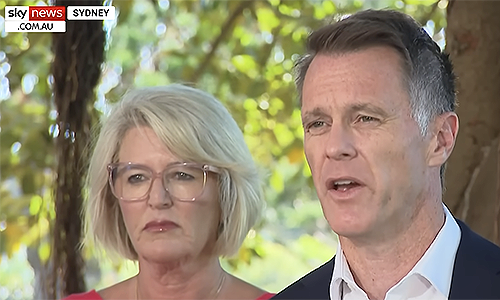


On Thursday, September 17, Opposition Leader Angus Taylor, Shadow Foreign Affairs Minister Ted O’Brien, and other senior members of the Coalition met virtually with Crown Prince Reza Pahlavi of Iran.
The meeting was significant not only because of the prominence of its participants, but also because it took place against the backdrop of the Islamic Republic’s continuing repression, Iran’s growing importance to Australia’s national security, and increasing calls from Iranian-Australians for Australia to engage with the person whom protesters called on in January to lead a democratic transition in Iran.
For many Iranians inside Iran and members of the Iranian-Australian community, the meeting carried a significance that went beyond ordinary political engagement. It demonstrated that some political leaders in the Western democracies are willing to listen to the Iranian people and engage directly with a figure who has become central to the opposition movement against the Islamic Republic.
The January massacre and the subsequent repression by the Islamic Republic regime left a deep mark on Iranians as a historical nation. For those who participated in or supported that movement, meetings such as this reaffirm that the universal cause of freedom and dignity has not been forgotten in the democratic world.
The significance of the meeting extends beyond the Iranian community. It reflects the extent to which Iran has become an Australian national-security concern.
In recent years, Australia has increasingly recognised that the Islamic Republic is not merely a distant foreign-policy problem. The Australian government has attributed attacks on Australian soil to the Islamic regime, expelled the regime’s ambassador, suspended operations at Australia’s embassy in Tehran, and listed the Islamic Revolutionary Guard Corps (IRGC) as a state sponsor of terrorism.
The security dimension has become still more apparent. On September 18, one day after the Coalition’s online meeting with Crown Prince Reza Pahlavi, ASIO Director-General Mike Burgess said he would not rule out the possibility that the regime could seek to assassinate prominent Jewish Australians.
This is important context for understanding why engagement with representatives of Iran’s democratic opposition is no longer simply a matter of foreign policy. The Islamic regime’s activities affect Australia directly through foreign interference, terrorism, intimidation of diaspora communities, regional instability, and the disruption of global trade and energy routes, including the Strait of Hormuz.

The Coalition’s meeting therefore demonstrates an increasing awareness within at least part of Australian politics that the future of Iran is relevant to Australia’s own national interests.
This broader strategic reality is also reflected in the failure of every attempt to install a political arrangement within the Islamic Republic. Trump’s six-month-long odyssey of finding a Delcy Rodriguez in the Islamic regime proved to the world that the only solution for stability in the Middle East lies beyond the Islamic Republic order of 1979.
For decades, Western policy was largely organised around managing the Islamic Republic: negotiating with it, containing its regional activities, and attempting to prevent escalation. Recent developments have shown that this approach has become impossible to sustain, to the point that the Albanese government, which largely disregarded the community’s warnings in previous years, has finally taken action following the terrorist attacks against Jewish targets on Australian soil.
The decision by senior Coalition figures to engage with Crown Prince Reza Pahlavi should be understood in this broader context. It indicates a willingness to consider not only how Australia should respond to the Islamic Republic as it exists today, but also what engagement with Iran could look like when the regime gives way to the alternative political order outlined in the Crown Prince’s Iran Prosperity Project.
This does not mean the Australian government predetermines Iran’s eventual political system. That is entirely up to the people of Iran. Crown Prince Reza Pahlavi himself has repeatedly emphasised that the Iranian people must determine their future through democratic means.
Pahlavi has presented himself as a bridge to a democratic political order. He has the historical legacy, popular support, and political vision to undertake this challenging task, and his declared four principles for national cooperation (territorial integrity, separation of religion and state, equality of all citizens before the law, and determination of the political system through democratic means) provide a framework for understanding this position.
These principles amount to a commitment to forming a national, modern government whose form is determined by Iranians themselves. They establish the conditions under which Iranians can exercise their political sovereignty.
One of the greatest challenges facing Western governments in dealing with Iran is the difficulty of obtaining an accurate understanding of political sentiment inside the country. The Islamic Republic tightly controls political expression, while much of the Iranian opposition operates either underground or in exile. The millions of people who took to the streets following the Crown Prince’s call on January 8 and 9 provided the world with a glimpse of sentiment across the nation and of what many Iranians want.
The Iranian diaspora has therefore played an important role here. The engagement of Iranian-Australians, not only through almost-weekly rallies in capital cities but also through engagement with Australian MPs, has helped place Iran’s repression, foreign interference, and the question of political transition more firmly on the Australian political agenda.
For the majority of us, Iranian-Australians, the Coalition’s decision to step forward is understood as more than a statement of Australian government-in-waiting’s position on Iran. It is a reaffirmation of a tradition deeply rooted in Western civilisation: that a nation struggling for freedom and seeking to determine its own political future should not be abandoned, and that those who stand with it should be willing to act. By taking this step, Australia has an opportunity not merely to respond to events in Iran and prepare for the change ahead, but to set an example for the wider West by demonstrating that liberty and human dignity remain universal values worth defending.
Reza Arab is an adviser to the Iran Prosperity Project and a lecturer at the University of Queensland.
The post What the Coalition’s meeting with Reza Pahlavi means for Australia appeared first on The Spectator Australia.