

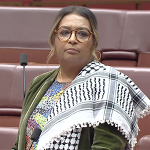


Penny Wong has said a regime that must murder its own people to keep power has no legitimacy. Yet when more than 18,000 Australians asked her to withdraw the recognition that still treats such a regime as Iran’s legitimate government, she refused. She said Australia recognises states, not governments. That stopped being true in 2019.
Let us review the background: Andrew Peacock’s foreign policy statement of February 16, 1979, granted de jure recognition to the Islamic Revolution’s interim government. Khomeini had appointed his unelected prime minister, Mehdi Bazargan, only 12 days earlier.
Peacock did not hide his reasons. He named the safety of Australians still in Iran, the need to get Iranian oil flowing again so energy markets could settle, and ‘the clearly expressed wishes of the Iranian people’. He even pointed to the first raid on the American embassy (February 14, 1979) and treated the new authorities’ success in freeing the staff as proof they could protect foreigners. Those were the grounds of the grant. Each of them now stands on its head. The regime Australia recognised for the safety of Australians has sponsored attacks on Australians in Sydney and Melbourne. The oil producer whose exports Peacock wanted restored has helped take the Strait of Hormuz hostage and push the shock onto Australian bowsers. The government he praised for releasing embassy staff became the world’s foremost practitioner of hostage diplomacy. And the ‘wishes of the Iranian people’ which he treated as the moral warrant for recognition, now run the other way. An overwhelming majority reject the Islamic Republic as their legitimate government. In January, millions took to the streets after Crown Prince Reza Pahlavi’s first nationwide call to protest. They knew the risk. They burned the IRI’s flag and raised Iran’s Lion and Sun in front of open fire. A horrific number of them were murdered for saying, in the only language left to them, that this regime does not speak for Iran.
Minister Wong agrees with them. She said it first on January 13: a regime that requires the murder of its own people to maintain authority ‘is not a regime with any legitimacy’. She said it again on February 12, and again on February 28, when the government put the same judgment on the record: a regime that relies on repression and murder to retain power is without legitimacy. The petitioners and the Foreign Minister have arrived at the same fact. The quarrel is only about what follows from it.
What followed, in her response to petition EN9283, was a list of measures already taken – sanctions, the expulsion of Iran’s ambassador, the suspension of our embassy in Tehran, the listing of the IRGC – and then an excuse. Australia, she told Parliament, has ‘a longstanding policy of recognising states, not governments’. The implication was that her hands were tied: she could punish the regime, describe it as illegitimate, and still could not touch the 1979 recognition because Australia no longer deals in governments at all.
That is the claim that does not survive contact with Australia’s own record.
The policy she is quoting is real, and it does not reach this case. On January 19, 1988, Bill Hayden announced that Australia would abandon the practice of formally recognising, or withholding recognition from, foreign governments. ‘From now on,’ he said, Australia would not extend de facto or de jure recognition, ‘…to new governments taking power in other countries.’ Relations with new regimes would be handled case by case. The point was to stop turning every coup into a blessing or a snub.
That rule is silent on the request in EN9283. The petitioners did not ask Canberra to recognise a new regime in Tehran. They asked it to withdraw a grant already made, in 1979, to an old one. Hayden never said that grant was frozen. He said Australia would stop issuing new ones.

Even if her reading of 1988 were right, the claim would still be out of date. The last time an Australian government could honestly treat Hayden’s rule as a longstanding government policy was seven years ago. On January 28, 2019, Marise Payne announced that Australia ‘recognises and supports’ Juan Guaidó ‘in assuming the position of interim president’ of Venezuela. That was recognition of a government. Labor, then in opposition, supported it. Donald Rothwell called it ‘a reversal of a previously long-standing government policy’. Once Australia was prepared to name a government, it cannot plead that naming – or un-naming – a government is a power it no longer has. If Hayden still binds the Commonwealth, the Guaidó statement was a breach. If Guaidó was proper – and her own party said it was – then Iran is a choice.
Revoking that recognition would not erase Iran, and it would not require Australia to appoint a government in Tehran. It would mean saying, in the same plain language used for Guaidó, that Australia no longer regards the Islamic Republic as the de jure government of the Iranian nation; that official dealings will be confined to protecting Australians and constraining a criminal regime; and that a future government emerging from the Iranian people will find the door open. That is not a leap beyond Wong’s own words. It is the step those words imply.
The petitioners asked her to close the gap between what she has said about this regime and what Australia still legally extends to it. She answered with a policy that stopped being a constraint in 2019. The honest remainder is not law. It is reluctance. Peacock tied recognition to the wishes of the Iranian people. Those wishes are now clearer than they were in the twelve days after Bazargan’s appointment, and so is the cost of ignoring them. A recognition granted in 1979 should not outlast a Foreign Minister’s own finding that the regime it blessed has no legitimacy.
The Islamic Republic – diplomatic face of the so-called Axis of Resistance and sponsor of the IRGC’s terrorist attacks on Australian soil – is not merely a source of disorder in the Middle East. It is a threat to Australia’s national interests. So long as Canberra keeps the Islamic Republic as Iran’s government, its remaining mission here keeps the legal roof of the diplomatic, consular and foreign-state immunity Acts: an accredited officer who cannot be arrested, a bag that cannot be opened, and a State that still arrives in court as a sovereign, not as a suspect. That is not a theory about 1979. It is the present tense of a recognition we have never withdrawn.
Arash Behgoo is the principal petitioner of House e-petition EN9283.
The post Penny Wong’s Iran excuse expired in 2019 appeared first on The Spectator Australia.