


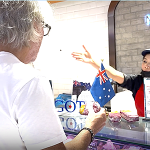
One Nation were extremely proud to launch their Victorian candidates in front of the Rebel News cameras.
Rebel News, many may remember, aligned themselves with the Freedom Movement in Victoria during the darkest days of the Daniel Andrews’ Labor regime.
While mainstream broadcasters took hundreds of millions in taxpayer dollars for Covid vaccine advertising and government assistance during the lockdowns – promoting unquestioned government propaganda, actively distorting truth, and discouraging critical safety questions – Rebel News stood with protesters as rubber bullets, pepper spray, and unforgivably heavy-handed policing intimidated people out of their rights. Their independent cameraman, Rukshan Fernando, provided an eternal record of government abuses of power in an era where many leaders would prefer the whole thing be swept aside and buried.
Transparency?
Not in a world where the state press takes over a billion dollars a year and media empires beg and scrape at the Treasury door for tax dollars while the internet rises up to replace them.
One Nation firmly supports the ‘free press’ as a pillar of democracy.
The question is – which press are actually ‘free’?
You decide…

In my opinion, the news channel that shared viral footage of a pregnant woman being handcuffed, beachgoers surrounded by armed officers, and pensioners being wrestled to the ground over mask violations, was doing its job. For this, they received door-knocks from police and thinly-veiled threats.
When One Nation is asked why it has given priority to independent media over The Guardian, ABC, and others – the reason should be obvious.
We reward those who upheld democracy and passed Australia’s first real test against tyranny since the war years.
Covid is important, because it was during this age of hysteria and sanctimonious propaganda that MSM died.
It wasn’t only a lesson about the need to reform our medical institutions and international oversight – it was a Litmus test on the relationship between the press and Parliament.
One that, MSM failed.
Qualified journalists, who have no excuse, presented obvious failures of logic and false claims from politicians as ‘fact’ – and persecuted anyone who dared to challenge them. Daily, they used their platforms and position of privilege, authority, and trust to encourage a culture of bullying and snitching between friends, family, and colleagues.
Had the press acted responsibly, politicians would not have been able to destroy so many Australian lives and livelihoods.
Instead, they shamelessly took the money.
And now they want to re-write the record and pretend they were ‘always sceptical’.
What rot.
What lies.
The same outlets who now refer to me as a ‘conspiracy theorist’ went all-in on the most damaging lies of the Fauci-driven pandemic response. Subsequent hearings and releases from the US have shown how misguided this approach was.
How many people were harmed? We may never know – short of a true Royal Commission.
The scars of that time, however, live on as legislation with sunset clauses and exceptional emergency powers Parliament was never meant to have.
A One Nation government will seek to amend these injustices and return a sense of normality to our nation.
In the meantime, Pauline Hanson has put some of the worst-behaved media networks and publications on notice.
Those who abused their position by fabricating outrage and misrepresenting One Nation in the past have been disinvited from high-profile events. And, like toddlers throwing a tantrum, they have stomped around and whinged about how ‘unfair’ it is that they were ‘banned’.
It’s a concern these politicians and competing media networks never extended to Rebel News or other independent conservative journalists who have been locked out of election press tours. Nor did they mind when the government sent orders to Silicon Valley to have their posts removed from social media.
My view is that the ABC and others are not genuinely distraught about the so-called ‘free’ press, rather they’re miffed about no longer holding a privileged position in the information economy.
Australians are not being denied access to One Nation, its policies, or its candidates.
Of all the political parties operating in this country, One Nation was the first to fully embrace social media and engage meaningfully with citizens. The ‘major’ parties rarely do this outside the lead-up to the election where they spend a few short weeks pretending to care about voters and then promptly slam the doors shut on public conversation.
I would argue that the cosy relationship enjoyed between the ‘major’ parties and legacy media networks, form the basis of an undemocratic system.
Why don’t they talk about the shadow bans and unspoken blacklists employed by networks where elected politicians are excluded from public discourse?
Media curates whose voices you hear.
They pick and choose who to exclude based on ratings, clicks, and personal bias.
Worse, for the ‘friendly’ politicians who appear daily, the comfy, pre-scripted questions and lack of proper questioning leaves me asking, why bother inviting them onto the screen? Media may as well print their press releases and move on.
Today’s media landscape looks nothing like the ‘rough and tumble’ debates of last century where politicians were perfectly capable of facing questions about their policies.
While One Nation puts an extraordinary amount of effort into each policy – and remains happy to answer detailed questions or even make adjustments following public feedback – you’re hard-pressed to find more than a few campaign lines embossed on professional (yet ideologically sparse) press releases from the other parties.
Given this, it does not surprise me that during the hysterical meltdown a few weeks ago, where I became the favourite chew toy of editors (who should be a lot more careful with their fact-checking and damaging false accusations), they took particular offence at my appearance on podcasts.
We’re always hearing Labor and the Coalition complain about Australians falling into ‘dangerous echo chambers online’. Ignoring that MSM is itself a dangerous echo chamber – the solution from the major parties appears to be to ban, restrict, or demonetise online discussions.
The whole of modern history tells us this approach is the least likely to change people’s minds or encourage a return to rational thought.
Instead, the lesson of Western Enlightenment has always been to err on the side of more conversation.
To have debates.
To talk to people whose views differ.
To challenge both yourself and others.
To wade into unfamiliar rooms and have difficult discussions.
How else can a politician hope to find out why it is that these voters have come to their views?
And so yes, I have made a point of going on many podcasts. Far more than most of my peers. I speak to everyone – from the largest and most controversial podcasters in America to start-up Australian journalists trying to break into the market. I’ve been on podcasts that host a wide range of topics – everything from forums on energy and its future, discussions about freedom of speech, I speak to medical professionals, I’ve spoken to economic professionals, Constitutional experts, Defence and Veterans podcasts, and conversations about migration. Most Fridays I speak directly to citizens about their concerns and catch people up with what’s going on in Parliament.
My peers on the other side of the blue, green, and red fence can scorn all they like – none of them are changing minds on their Insiders love-in.
The childish response to my record of sharing public discourse reveals how threatened media and politicians are by the simple act of talking outside the Canberra Bubble. Or should we say, safe space?
Last week, my critics were thoroughly embarrassed.
The ABC callously and wrongly ridiculed a discussion I had regarding the possibility that Covid vaccines could have an impact on miscarriages calling it a ‘debunked conspiracy theory’.
Referring to these as ‘unreported’ (meaning the ABC weren’t paying attention) livestream conversations with ‘anti-vax mandate activists’.
Well, yes, we still take the position that mandated Covid vaccination, on threat of job loss and lock-outs, was morally wrong and reprehensible. This is a mainstream view in hindsight, we might remind the ABC… Their articles continued to promote being ‘anti-vaccine mandate’ as if it were a bad thing.
My interviews were held during the early days where the exact numbers and data were not known. It was a conversation about whether a risk to pregnant women existed at a time when women were being denied proper risk assessment. These women were contacting our office. They felt as if they were being lied to by authorities.
Well, we were right to ask questions. We were right to have discussions. And we were right to raise the alarm on possible harm to pregnant women.
Dr Anthony Fauci’s 2021 texts, revealed by Donald Trump’s executive order, show there was a discussion about ‘weigh[ing] the potential risks and benefits’ regarding pregnant women taking Covid vaccines.
Two vaccines in the US, Pfizer and Moderna, had been granted emergency use while data was still being collected on pregnant women – in other words, they didn’t know the risk profile.
These texts reveal that Fauci was aware of ‘fevers’ and ‘cytokine storms’ occurring in patients after the second dose which ‘theoretically could be associated with miscarriage in the first trimester’. To which other experts replied, ‘Good point.’
The Health and Human Services Department in the US no longer recommends these vaccines for pregnant women or healthy children.
Our position has always been transparency. This means freedom for doctors and medical professionals to voice their concern without fear of losing their jobs – and freedom for Australians to have access to honest medical information, not ‘risk-assessments’ decided in the dark by foreign bodies and boards that we did not elect.
It is the ABC who failed and it is the ABC who should apologise for that failure to the Australian people.
Politicians such as myself were elected to have these conversations when others cannot, because we have additional protection. It’s shocking that Australia has reached a point where seeking data and questioning ‘authority’ has become an excuse for the ‘trusted’ media to whip themselves into a frenzy.
Perhaps if they asked more questions, they wouldn’t need taxpayer dollars or legislative assistance to survive.
The post Who are the real ‘free press’? appeared first on The Spectator Australia.
