








Whenever a car indicates it wants to turn off the insanely busy road into our driveway, he blows his whistle and holds up his flag to stop pedestrians so the car can complete the manoeuvre quickly, with minimal disruption to the hundreds of motorbikes and other cars behind it jockeying to get ahead on the six-lane thoroughfare.
There are, in fact, hundreds of these men all over Bangkok. Despite them inhaling car fumes all day and being deafened by loud traffic, I haven’t seen one who looks even slightly resentful or miserable.
FLOWING
Thai people routinely show them respect for doing a job that helps keep the busiest parts of the city flowing in a way that traffic lights or machines never could.
The bloke outside my apartment is particularly happy in his job.
He started recognising me a week or so after I moved in, and would exchange a polite “Sawasdee khrap” (hello) as I passed.
One morning, distracted, I forgot to greet him. I was a couple of metres past when I heard the abbreviated “khrap” come forlornly from his kerbside post.
I immediately turned and gestured an apology while greeting him.
That was the moment when our daily exchange became a ritual, and their formality began to escalate in the most endearing and hilarious way.
For some reason, these Bangkok traffic wardens occasionally salute drivers as they pass in or out of the driveway.
The guards at the entrances to major shopping centres do likewise to passing pedestrians. I don’t know why they do this.
t must have something to do with their uniforms, which in some cases look like a mix of police officer, army soldier and doorman at a burlesque night club.

Their heels have metal plates so they can loudly click them together when they stand to attention should they feel the urge to be extra formal, which they sometimes do with notable enthusiasm.
I’ve never been in the army. The only way I know how to respond to a salute, which I suppose I gleaned from the World War II movies I watched as a kid, is to salute back.
And that is exactly what I instinctively did the first time my local traffic warden saluted me.
Since then, our daily exchange has escalated and escalated, to the point where it now resembles two opposing generals approaching each other on the battlefield to celebrate a cessation of hostilities.
If he sees me approaching, he stands behind a lamppost, ready for me to walk into view, then clicks his heels and yells “Sawasdee khrap” with more gusto than is customary to laidback Thais.
Other pedestrians are often startled – and stare confusedly.
I too stop, stand at attention and return the salute.
My Thai vocabulary now includes “Sabai de mai?” (how are you?), to which he replies with, for all I know, the Thai equivalent of, “All the better for seeing you, sir.”
JOYOUS
It’s a beautiful, joyous, ongoing joke between two men who don’t even speak the same language.
I recount this as a contrast to what is happening in Australia these days.
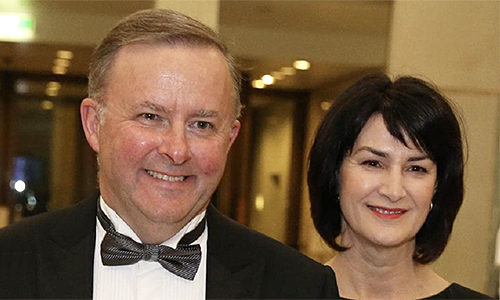
Prime Minister Anthony Albanese is rightfully copping enormous flack for having exploited – and enlarged – the fundamental social schisms that are tearing Australia apart.
The nation has reached a the point where terrorism and political violence have been normalised under him.
But while Albanese has cynically used those schisms to his advantage, he didn’t create them. We did.
Australians discarded their fraternal bonhomie decades ago. Mass immigration and the increasingly hostile nature of political debate have exacerbated this process, but the seeds of discord were planted by us first.
In most places around the world it is considered rude not to exchange a few words or even crack jokes with strangers in a lift or a queue.
But in Australia, such unsolicited approaches are almost always treated with suspicion or contempt.
According to this amusing and accurate skit by the Reece Bros, the polite convention in Australia is to subtly nod downwards at passers-by – nothing more and nothing less, as the skit’s pantomime conclusion demonstrates.
It makes for an amusing video, but it’s hardly a solid foundation on which to build a society of strangers.
Even people who know each other have ridiculously narrow rules of engagement.
I’ve written about this before, but one of the reasons I left Australia was that Australians struggle enormously with talking about anything but themselves.
It’s unbearably depressing and boring. And it needn’t be so.
Last weekend I was lucky enough to attend the annual Battle of Ideas in London, which is a banquet of debates in one three-storey venue across two days.
At any one time there are 10 panel discussions on a wide range of topics in various-size rooms, with five time slots per day.
The speakers are all experts, academics, writers and eccentrics, but it is the interactions with the audience – which take up most of each session – that are the highlight.
The people who attend these events are comfortably opinionated and relish a bit of verbal jousting with strangers. There’s rarely a dull moment.


Australia has to start all over, its been trashed economically, spiritually and culturally. Restoring the original constitution is all that is required to do a ‘DOGE’ on Canberra and burn off the Bureaucrats BS.