






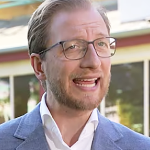
What should we make of Andy Burnham’s latest manoeuvres on EU membership and migration? One of the reasons he gives for reversing or partially reversing Brexit, such as joining the single market with its requirement for free movement of people, is that leaving the EU changed the nature of immigration to the UK. The Prime Minister told the Sunday Times that ‘revolving door migration, where people would come and then go back’ – the kind Britain had more of under EU membership – was ‘different’. Different to what exactly? Since Brexit, he said, ‘The balance of migration has changed, hasn’t it, since then? I think we’ve just got to have an honest discussion about these things’.
Expanding on his point in an interview on Good Morning Britain, he argued that ‘longer term, permanent migration’ had ‘replaced what was freedom of movement’. Burnham placed the blame on ‘the Boriswave’. It is telling how much the Overton window has shifted rightwards on this issue that a soft-left Labour prime minister is willing to use that term, and on breakfast telly of all places. He defined the Boriswave as ‘a huge number of people’ who came ‘seeking permanent settlement on longer term visas’, and warned: ‘A new problem has arisen for Britain in terms of how do we handle that form of migration in the long run.’ This, he said, reflected the ‘weaker control’ over borders caused by Brexit, which he also credited with creating ‘the small boats crisis’ because ‘we can’t return people and people know we can’t do that in the same way that we used to be able to do’.
This last point is dubious. Five countries accounted for 66 per cent of illegal boat migrants in 2025/26: Eritrea, Sudan, Afghanistan, Somalia, and Iran. It’s hard to think of five countries Britain would be less able – or willing – to refoul people to, especially if they claimed asylum protection. Burnham might have in mind the possibility, in the cases of those who don’t present as refugees, of returning them to the single market/EU member state from which they entered Britain – in most cases, France – but good luck getting the French to agree to this, regardless of whether there is a President Le Pen in the Élysée Palace. As for the potential for single market nations cooperating to prevent illegal free movement across their territories in the first place, the very nature of a borderless European utopia makes that acutely difficult.
We will see what emerges from next month’s European summit but it is unlikely to produce measures capable of restoring Britain’s ability to enforce its borders, not least because the power to do so ultimately – and already – lies with Britain. The only reliable means of removing anyone who enters Britain informally is by removing the legislative barriers to doing so, beginning with the relevant provisions of the Human Rights Act.
The Prime Minister is on sturdier ground when he speaks of the Tories’ record on migration. A succession of Conservative governments oversaw a transformation not only in the volume of immigration (legal and illegal) but in the nature of immigration. The Prime Minister addresses the matter of longevity of stay or settlement, but he could just as easily have cited the changed demographics. In the year ending June 2016, 69 per cent of migrants came from within the EU and 31 per cent from the rest of the world; by December 2023, it was 8 per cent from the EU and 92 per cent from everywhere else. Well, he couldn’t have cited it, because the unholy trinity of progressivism – the BBC, Bluesky and his backbenchers – would have worked themselves into a collective paroxysm of outrage. But those who recognise that multiculturalism is a failed and divisive ideology would certainly note the radical shift from sourcing two-thirds of migrants from culturally similar Europe to sourcing more than nine in ten from cultures farther afield, some of which Britain neither can nor should wish to assimilate.
This is important. I broadly agree with Burnham’s analysis of how the Tories used Brexit to fundamentally change immigration for the worse. I believe him when he says he wishes to rebalance the system back towards short-term work and study stays by young people who then return home. I suspect a reversion to free movement of people (i.e. single market membership) is the readiest means of achieving this, and would likely go some way to assuaging tensions around migration, asylum, boat crossings, and to an extent their unintended social fallouts (crime, Islamic extremism, the burden on public funds).
But I cannot see Burnham ushering free movement back in while turning off the tap on arrivals from developing nations. It would be an entirely reasonable, respectable policy decision but the unholy trinity, and plenty beyond it, would decry the ‘optics’ of a Labour government prioritising migrants from majority-white European countries while shutting down entry routes from African and Asian lands. The moral dynamics of progressivism simply do not permit such a policy. A government that sought to maximise the most desirable and minimise the least desirable migrants, as it perceived these categories, would be engaging in impermissible discrimination. Britain’s immigration system must reflect equity of national origin and culture in its distribution of visas or it is an inherently racist and xenophobic system. These are the rules now.
No Labour government could have got us here. None would have dared. Put Tony Blair’s border policies in front of the average right-winger today and they’d have your arm off grabbing for them. It took the Tories to unleash open-borders radicalism on Britain. The left will fight to retain the Tory immigration legacy because it is what they believe in but could never have delivered themselves.

The post What Andy Burnham can’t admit about migration appeared first on The Spectator Australia.
