







Every sitting day in the Western Australian Legislative Council begins with the same small act.
Before the debates, the interjections, and the political point-scoring, the chamber falls silent.
The President reads the Council prayer and the Lord’s Prayer.
The whole thing takes less than a minute.
Across the corridor, the WA Legislative Assembly’s Procedure and Privileges Committee is considering whether the Lord’s Prayer should remain part of that House’s proceedings or be replaced by a period of silent reflection.
The Assembly will, no doubt, determine its own procedures.
As a member of the Legislative Council, I do not consider it my place to instruct another House.
Though the question it finds itself considering at present does raise a broader issue: what are parliamentary rituals even for in the first place, and what do we stand to lose if we discard them?

To say the least, I should be plain about where I stand.
For full disclosure, I do identify as Christian.
When the Lord’s Prayer is read, I hear it as prayer and not merely as a cultural performance or historical curiosity.
That said, the public case for retaining it is not merely confined to Christians.
My generation understands ritual better than we sometimes admit.
Vinyl records are back.
Film cameras have returned.
People keep handwritten journals in an age when every thought could be stored in the cloud.
We do not choose these things because they are more efficient.
We choose them because a ritual slows us down, gives shape to a moment and connects us with people who performed the same act before us.
The Lord’s Prayer in Parliament is that kind of inheritance, but it is more than that, because its words still have something to say.
It asks for what is needed rather than what is desired.
It speaks of forgiveness given as well as forgiveness sought.
It recognises temptation, wrongdoing and the need for deliverance.
It places human beings, including legislators, under a moral authority greater than their own ambitions.
In a chamber built for assertion, it begins the day by diminishing the ego.
And that matters.
Politics in 2026 runs at the speed of a phone notification.
Everything becomes content, every disagreement becomes a clip, and every clip is designed to provoke a reaction before reflection has had a chance.
Against this backdrop, asking members to stop briefly before the noise begins is not an obsolete habit.
It is a small act of institutional discipline.
More importantly, it reminds every member that we are temporary custodians of something larger than ourselves.
Guess what, we may only hold office for a time. The institution existed before us and, if we serve it properly, will endure long after our names have been forgotten.
So, I say, a little institutional humility is not something modern politics has in abundance.
There is, of course, a serious argument on the other side. Western Australia is religiously and culturally diverse.
Parliament belongs equally to Christians, adherents of other faiths, and those who profess no faith.
No member should be regarded as less entitled to belong because he or she does not join in a Christian prayer.
Those concerns deserve to be treated seriously.
But pluralism need not require our institutions to begin from a cultural blank slate.
A society can retain an inherited Christian practice without making Christian belief a condition of public service.
Respecting a tradition is not the same as compelling assent to it.
A member who remains silent has not failed a test of faith.
There should be no such test. Freedom of religion necessarily includes freedom not to participate.
Some propose replacing the Lord’s Prayer with silent reflection.
That would preserve the pause, and I understand its attraction.
But it would not preserve everything.
Silence can calm us.
An inherited prayer also connects us to generations past and gives moral content to the moment.
A generic pause asks each person to think whatever he or she wishes.
The Lord’s Prayer asks something more demanding: that we consider forgiveness, temptation, obligation, and our dependence upon something beyond ourselves.
Not every tradition deserves to survive merely because it is old.
Some traditions do become walls and should be removed.
But age is not, by itself, an argument for abolition either.
Before discarding an inherited practice, we should ask what work it performs.
This one asks powerful people to pause, to recognise their limitations and to remember whom they serve.
That purpose has not expired.
In an age of hot takes, permanent outrage and political self-importance, it may be more necessary than ever.
Each House must reach its own decision, with respect for both tradition and individual conscience.
My own view is crystal clear.
I for one hope that the prayer is retained.
I hope the freedom not to join in it is equally respected.
And I hope Parliament keeps that brief moment in which its members are reminded that political power is temporary and moral responsibility is not.
The argument is not that nothing should ever change.
It is that we should not confuse removal with progress.
A prayer and a moment of stillness before the shouting starts are not relics.
They may be among the most modern things Parliament does.
The Hon Anthony Spagnolo MLC is a Liberal Member of the Western Australian Legislative Council.
The post Before the shouting starts appeared first on The Spectator Australia.
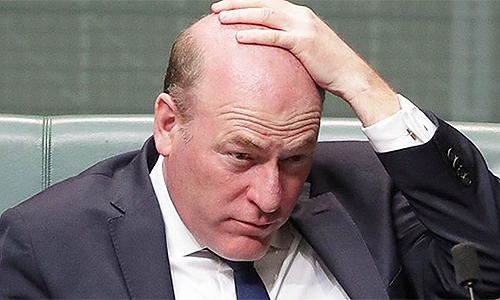

Some know the difference between right and wrong and a lot need to be reminded.