





How times have changed.
The loyalty Australians felt towards the Crown back then, as Andrew himself has now made clear, was somewhat misguided.
BETRAYAL
What once symbolised honour, decency and tradition now symbolises betrayal, debauchery and, if one obscure page in the recently released Epstein files is anything to go by, accessory to murder.
Who’d want to live on a street name like that?
Curiously, the residents are ambivalent.

Asked by local authorities if they want the street renamed after someone who is not a key member of a powerful paedophile ring, the good burghers of Prince Andrew Ave said they couldn’t be bothered.
“I’ve got no problems with it being called Prince Andrew Ave,” resident Liam McCallum later told The Age newspaper. “It’s just a street name.”
And that’s the issue. It wasn’t “just a street name” in 1960. The loyalty to the Crown that formed a reassuring catalyst for post-war Australia’s independent culture might have been misguided, but at least it was loyalty to something.
What’s replaced it in these post-modern, post-colonial, post-religious, post-whatever times is at best a boring form of ennui, at worst a depressingly vacuous, suicidal nihilism.
In their defence, there is one valid reason why the residents might be reluctant to change the name of Prince Andrew Ave.
One of the consequences of all this cultural disengagement is the emergence of a bureaucracy that makes everything twice as complex as necessary in order to justify its own existence.
One imagines that changing a street name these days is no longer a matter of a single clerk filling out a simple form and sending a man with a ladder and a screwdriver out to change the signs – but instead requires focus groups, a First Nations cultural sensitivities survey and an environmental impact statement.
You can sympathise with residents who might have calculated that all that bureaucracy is more daunting than simply having to crack the same “It’s between Hitler Street and Stalin Crescent” joke on the rare occasions they are asked to provide their street address.
But that’s only because modern Australian culture offers no other alternative.
Pretty soon the suburb will be filled with Third World immigrants anyway – and the historical significance of Prince Andrew Ave will be as familiar to the street’s residents as lamingtons are to Somalian street vendors.
This destruction of institutions and dilution of culture are alarming enough.
But they fit a much larger, even more alarming global pattern, of which the COVID lockdowns, vaccine rollouts, Paris Agreement, mass immigration, censorship and the forthcoming central bank digital currencies are just the latest examples.
Until this week, only conspiracy theorists imagined that the whole thing had been cooked up by a shadowy cabal whose proxies masquerade as democratically elected representatives.
Yet, as Mark Steyn, among others puts it, it’s all so improbable “that someone must have consciously implemented it”.
It certainly makes you wonder anew about the culture wars here in Australia, which began in the early 1990s under Paul Keating.
REMAKE
“We must remake Australia,” he said on Australia Day 1992, a mere month after wrestling the prime ministership from Bob Hawke.
Keating was preoccupied with severing ties with the monarchy and reinventing Australian culture, although he never did get around to fully explaining what he intended to replace it with.
All he said was that we would be more multicultural and “confident”.
We now know that multiculturalism was partly a ruse to fill western Sydney electorates – Keating’s Blaxland electorate included — with Muslims.
Their unwillingness to assimilate and their dependence on welfare made them reliable Labor voters, a strategy whose fruition can be measured by the number of dead bodies on Bondi beach.
The supposed “confidence” imbued in his vision was just a red herring to help his sycophants in the media sell the idea.
Thirty years of multiculturalism later, Australia is less confident than it’s ever been. In hindsight it is clear Keating was more interested in stroking his own massive ego than serving his constituents.
But at least he was original. Or an early adopter.
The Keating playbook of enriching a nation by diminishing its original culture and criminalising criticism has since been adopted and embellished by Tony Blair, Justin Trudeau, Emanuel Macron, Keir Starmer, Mark Carney and now Spanish Prime Minister Pedro Sánchez – most of who managed to last longer in office by at least appearing to be slightly less like obnoxious wankers.
This cabal has some characteristics in common, and occasionally overlaps, with Jeffrey Epstein’s powerful network.
In old emails released this week, Epstein occasionally referred to “goyim”, the pejorative term elitist Jews use to refer to inferior non-Jews, which isn’t a million miles from Keating’s attitude to ordinary Australians.
(Keating’s daughter, Katherine, was drawn into Epstein’s social circle in New York in 2011 through her friend Prince Andrew. There is no suggestion, of course, that either she nor her father had anything to do with Epstein’s unsavoury activities.)
Australians quickly saw through him, though, and elected John Howard in a landslide soon afterwards, in 1996.
Howard’s victory would have been flawless if not for one person: Pauline Hanson.
Hanson began that election campaign as the Liberal candidate for Oxley, a working-class seat in the outer suburbs of Brisbane.
She was dis-endorsed on the eve of the election after she controversially – but sensibly – said that Aboriginal welfare was “reverse discrimination”.
She ran as an independent and won the seat anyway.
She immediately became a thorn in Howard’s side.
In her maiden speech, she said Australia was “in danger of being swamped by Asians… (who) have their own culture and religion, form ghettos and do not assimilate.”
She also called for multiculturalism to be abolished.
Howard was torn. He had to mollify his Asian counterparts and the burgeoning domestic Asian constituency, but couldn’t outright dismiss Hanson because her white supporters were his supporters too.
In many ways he even agreed with her on multiculturalism.
OUSTED
He was forced to respond not with principles but with political expediency, hoping Hanson would one day go away.
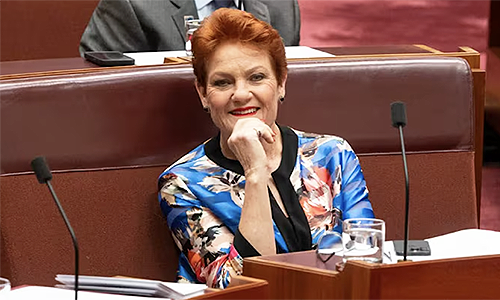
She didn’t, and now, by sticking doggedly to the principles upon which she was elected 30 years ago, she is more popular than the Coalition Howard once led, not to mention a viable threat to the cabal.
Keating explained his opposition to Hanson in a famous speech he delivered at the University of NSW in November 1996, eight months after being ousted from office. It was titled The Myth of Monoculture.


The thrust of this piece is accurate. However ON policy headlines lack body copy. That is not unlike the Coalition right now however the comparison will become sharper if Taylor-Hume get into full gear, as I expect.
My wish is ON creates a Senate wedge.
A task for the Coalition is to regain at least the preferences from those who vote ON 1. Not easy, suspect some Labor originating ON voters will revert to Labor.
It is all to play for right now.
Around the time of the 1996 election I met a gent who was recently back from SE Asia. I asked him if the media frenzy over Pauline was being echoed there.
He said it hadn’t registered a single blip. And added, ‘Anyone who thinks Australia is racist has never been to Asia.’
Fair point. The ‘anti-racist’ brigade still has a way of making it sound as if racism was an Australian invention.
Yes, having been in and around South East Asia from the early 70’s I can confirm the master and servant relationships that existed in Singapore, Thailand, Malaysia and Hong Kong. Not so in Taiwan and Japan. The language tone become very obvious. Representing a major shareholder was an eye opener. I have noticed it amongst SEA immigrants towards Australian women in particular.